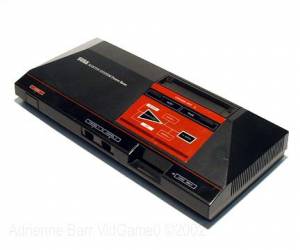
The Sega SG-1000 Mark III was the next game console
in the SG-1000 series after SG-1000 Mark I and SG-1000 Mark II (an
updated Mark I). It was released in Japan in 1984 to compete with the Nintendo
Famicom and designed similar to the Mark II. The parts inside are
similar to the MSX computer and SG-1000 but have been improved. The
system would take its own cartridges as well as Sega Cards and SG-1000
carts. The Sega Cards are the same ones that are compatible with the
SG-1000 card catcher add-on, but the card catcher is now built-in to the
Mark III console.
The system was redesigned and renamed the Sega Master System when released in the US in June 1986, a year after the Nintendo Entertainment
System, and sold for US$200. The Master System was released in other
places soon after including Japan again (in November 1987), but in its
new form. The system failed to make the impact in America that Sega had
hoped for, mostly due to support for the dominant NES with its exclusive
third-party developers. The Sega Master System sold 125 000 units in
its first four months, but in the same time, Nintendo sold 2 million NES
consoles.
Nintendo had 90% of the market in America, and it would have taken a
big effort to win over them, so Sega CEO Hayou Nakayama decided he did
not want to waste too much effort trying to market a console in a market
already largely dominated by a larger company, so in 1988 Sega handed
over the marketing of the console to Tonka Toys. But this was not a good
move and made matters worse. Tonka had never marketed a console before
and basically had no idea what to do. The Sega Master System went
nowhere during this period.
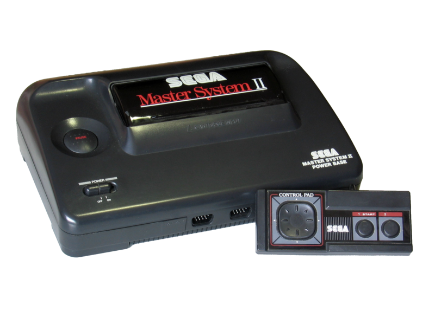
In 1990, after the Sege Genesis
had been established and was selling well, Sega got the marketing
rights to the Master System back from Tonka. They released a new
designed console with new packaging and called it the Sega Master System
II. This new version was made smaller and to reduce costs it included
no reset button, power light, card slot or expansion port. Sega did
everything that Tonka didn't to try and market this version, but didn't
get much from it. At least at this time, the Genesis was doing well for
them. The Master System was supported for a few years more in the US.
In Europe, there is a
different story about the Sega Master System. It was marketed in many
countries, including some where Nintendo had not yet ventured to. There
was lots of third party support for the system in Europe and it outdid
the NES
In effect, Nintendo had to license some popular Master System titles to
the NES to try and make some sales. The console was supported by Sega
in Europe up until 1996 when it was discontinued so that Sega could
concentrate on the Saturn.
In Australia, the Master System did not do as well as the NES but
still did not suffer as much as it did in America. Another success
story for the Master System comes from Brazil, where the console was
marketed by Tec Toy. They released a Sega Master System III and other
variations. They also translated some games
and changed characters to be more appealing to Brazilian audiences.
They even ported some Game Gear games to Master System cartridges and
made some new Master System games. It is perhaps because of the game and
console production that was more close to home for the Brazilians that
the Master System did so well. The console was supported until 1997.
The Master System had some success in the world, but was a major
failure in the US. Sega would have learnt more about marketing a console
and that's why their next console, the Genesis, was their most
successful console. But it is because of the Master System that Sega was
able to get into the worldwide market and make the Genesis a success.